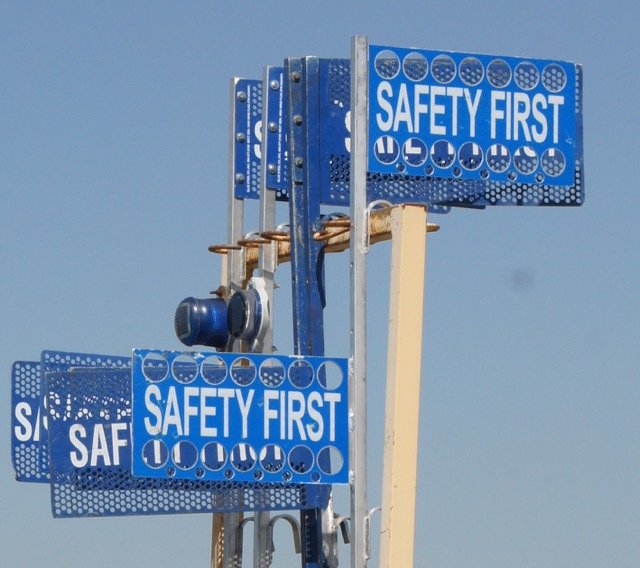
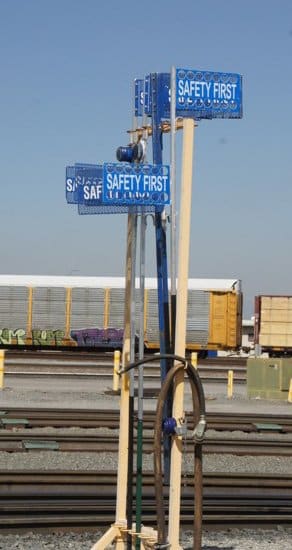
Blue flagging protects railroad workers from being struck or crushed by moving equipment while they work on or beneath locomotives, railcars, and other rolling stock. Federal law requires it. Violations carry serious civil penalties. And the physical blue flag itself — the aluminum staff in your hand — is the last line of defense between your crew and a moving train.
Blue SteelCo has manufactured FRA-compliant blue flags for railroad maintenance facilities, transit authorities, and industrial rail operations since 1997. Every flag ships from our facility in the United States.
What Is Blue Flagging?
Blue flagging — formally called Blue Signal Protection of Workers — is the federally mandated practice of displaying a blue signal (flag, light, or flag/light combination) to indicate that workers are on, under, or between railroad equipment. When a blue flag is displayed, the protected equipment may not be moved, coupled to, or have any car placed against it until the employee who placed the blue signal removes it.
The rule exists for one reason: workers in rail maintenance environments are at constant risk of being struck by equipment they cannot see moving toward them. A blue flag is a legally recognized stop signal — not a courtesy, not a suggestion.
FRA Blue Flag Regulations: 49 CFR Part 218
The federal governing authority for blue signal protection is the Federal Railroad Administration (FRA), operating under 49 CFR Part 218 — Railroad Operating Practices, Subpart C: Blue Signal Protection of Workers.
Key requirements under 49 CFR Part 218:
§218.23 – Blue signals required: Blue signals must be displayed when any employee is on, under, or between railroad equipment performing any service
§218.25 – Stationary on-track equipment: Blue signals must be used when equipment is at a shop, roundhouse, repair track, or inspection pit
§218.27 – Working from the ground: Additional protections apply for employees working from the ground alongside equipment on a main track or siding
§218.29 – Display and removal: Only the employee who placed the blue signal may remove it. This is non-negotiable. A foreman, supervisor, or other employee may not remove another worker’s blue flag.
§218.31 – Visibility: Blue signals must be clearly visible to any employee who might otherwise move the equipment
FRA enforcement: Violations of blue signal protection rules are serious regulatory offenses. Railroads and individual employees can face civil penalties up to $29,906 per violation (2024 indexed rate). In fatal incidents, criminal charges are possible.
Who Must Use Blue Flags?
Blue signal protection requirements apply to:
Class I, II, and III freight railroads regulated by the FRA
Commuter rail and passenger rail operators
Railroad maintenance-of-way (MOW) crews
Locomotive and car repair shops — whether railroad-owned or contract maintenance facilities
Transit agencies that operate on freight rail trackage (shared corridors)
Industrial switching operations at manufacturing plants, ports, and intermodal yards
Transit systems operating exclusively on their own fixed guideway (subway, light rail) typically fall under OSHA jurisdiction rather than FRA. However, many transit agencies voluntarily follow FRA blue signal standards as a best practice — and some state public utility commissions require it.
Blue Flag vs. Blue Light: What’s the Difference?
FRA rules permit three types of blue signals:
Signal Type
When Used
Blue flag (daytime)
Standard on-track protection during daylight hours
Blue light (nighttime)
Required when visibility is insufficient for a flag alone
Flag + Light combination
Used in low-light shops, tunnels, and covered maintenance facilities
In shop environments — roundhouses, covered repair tracks, maintenance bays — blue lights are often required in addition to flags because overhead lighting doesn’t always provide the contrast needed to see a blue flag clearly. Blue SteelCo manufactures both flag hardware and compatible blue signal light mounts.
Blue SteelCo Blue Flag Products
Shop the flags: the full Blue SteelCo line — Next Gen High Wind, Standard, Track Flag, and the Fuel Truck flag pair, with catalog numbers — is on the Blue Flag Safety Equipment page.
Blue SteelCo manufactures three blue flag models, each built for specific yard and shop conditions. All are welded aluminum and steel, made in the USA, engineered for the rail maintenance environment — wind, grease, tight clearances, and the need for a fast, secure display every shift.
Standard Blue Flag — SH10400M
The SH10400M is the standard railroad blue flag for everyday yard protection: an aluminum staff with a powder-coated blue signal panel, built for trackside placement in normal weather conditions. Used across Class I, short line, and industrial railroad operations for compliance with 49 CFR Part 218 blue signal requirements.
High Wind Blue Flag — SH10050CM
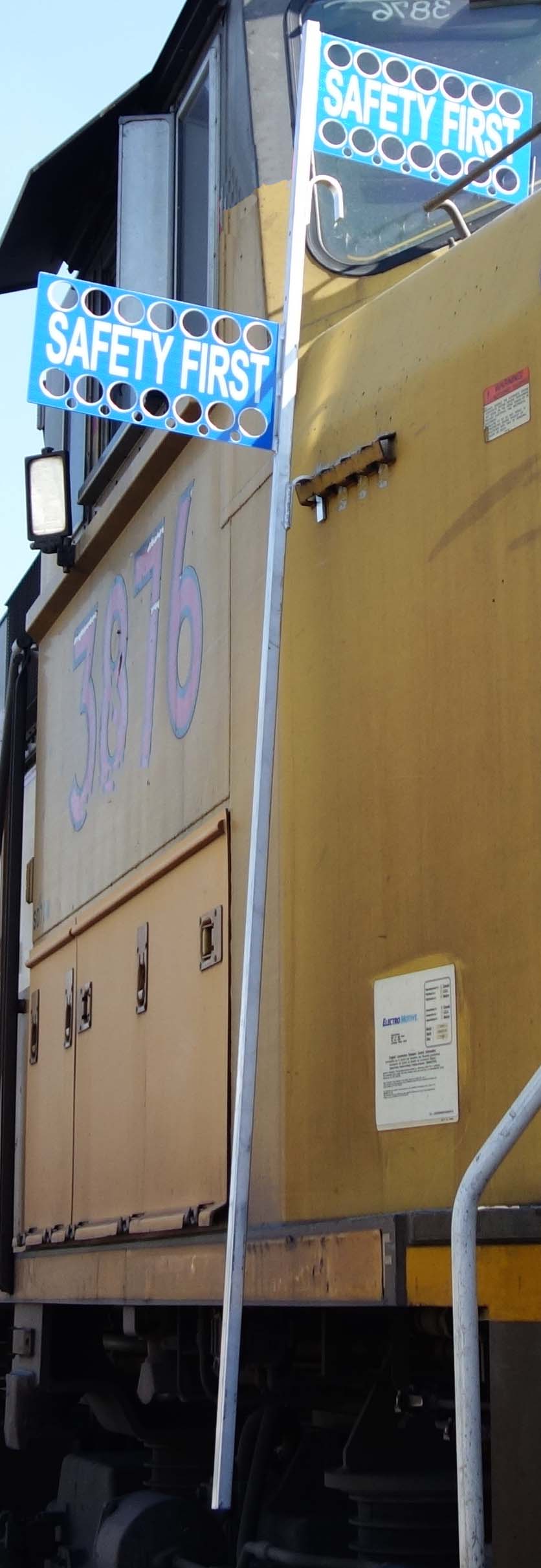
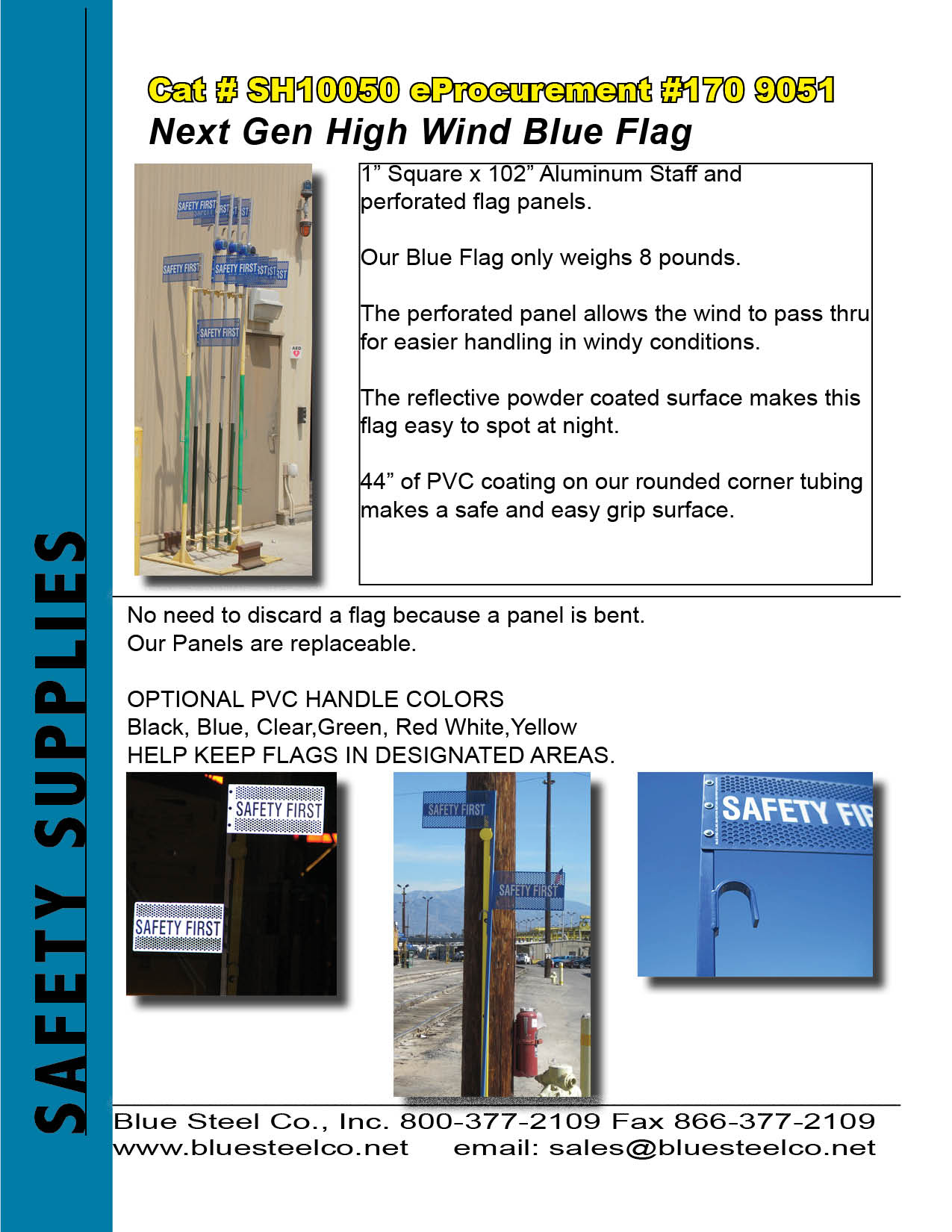
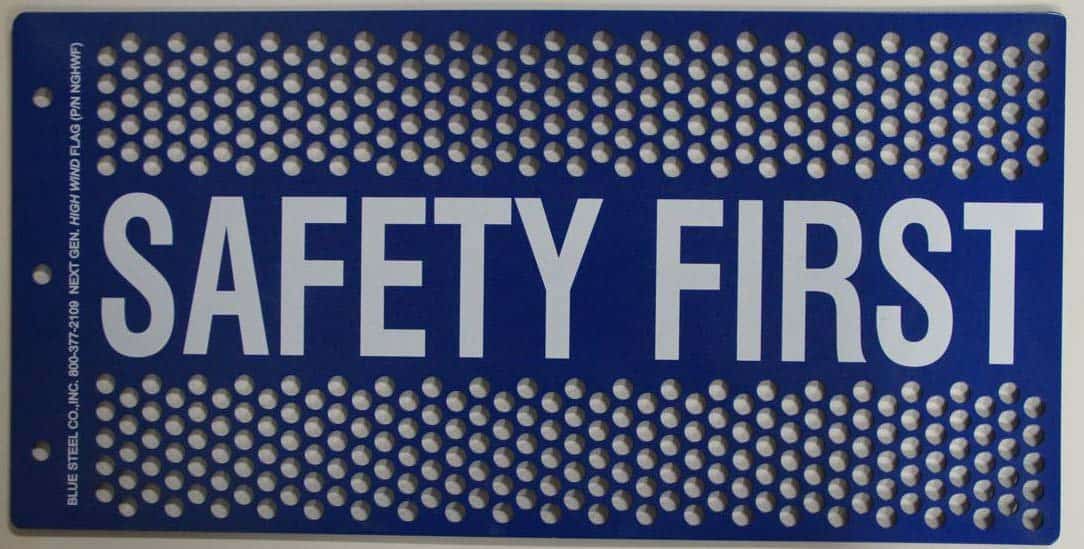
The SH10050CM High Wind Blue Flag solves the #1 complaint from maintenance crews: flags that become a liability in crosswinds. Two perforated panels (.100″ x 9.5″ x 19″) let air pass through while maintaining full visibility, so your workers aren’t wrestling a flag into position or watching it tear away from the staff.
Product specifications:
Staff: 1-inch square aluminum tube, 102 inches (8.5 feet) — standard for over-the-rail display — with radius corners for safe, comfortable gripping
Grip: No-burr handle with PVC shrink tubing at the grip zone
Panels: .100-inch thick, precision-cut, powder-coated blue with reflective messaging applied
Ventilation: Perforated panels with multiple hole patterns — large holes for primary wind flow, smaller holes across the bottom for tag-out clips
Weight: 8 lbs
Construction: Bolt-together panels — replace a bent or damaged panel without replacing the staff
Union Pacific stock item #170 9051 0
In-House Magnetic Blue Flag — SH10401M
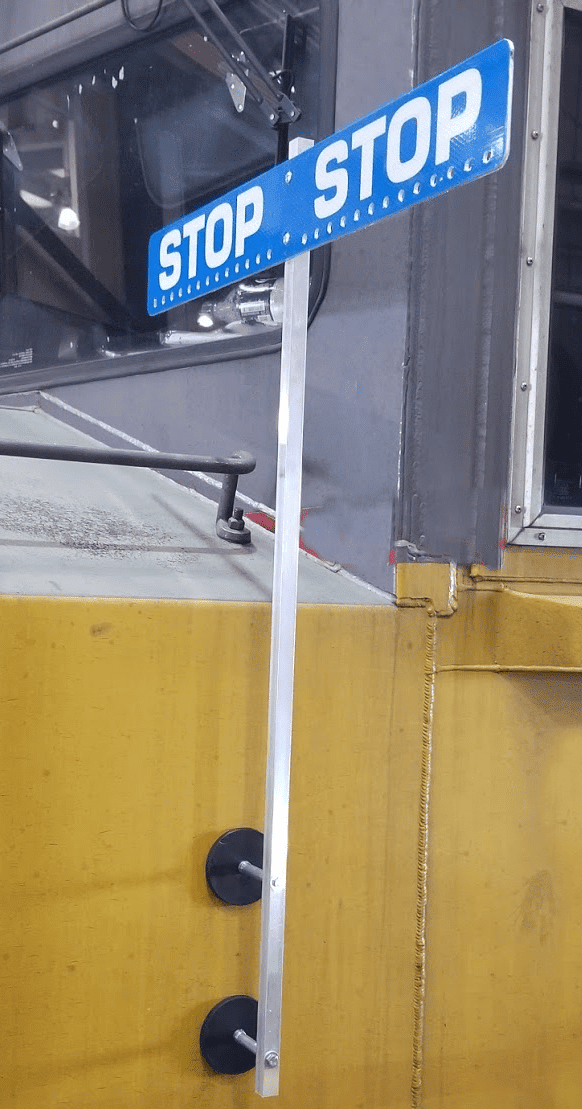
The SH10401M in-house blue flag mounts directly to rolling stock or shop equipment with a magnetic base and a compact 40″ staff, with a STOP or Safety First message panel. Designed for indoor maintenance bays, locomotive shops, and enclosed repair facilities where a full-height trackside flag is unnecessary but blue signal protection is still required by regulation.
Model Comparison
Spec
Standard (SH10400M)
High Wind (SH10050CM)
Magnetic In-House (SH10401M)
Staff
Aluminum
1″ sq. tube aluminum, 102″
40″, magnetic base
Panel
Blue signal panel
2 perforated panels, .100″ x 9.5″ x 19″
STOP / Safety First flag
Finish
Powder-Coated Blue with Reflective Message
Powder-Coated Blue with Reflective Message
Prismatic Blue background with White Letters
Mounting
Trackside ground placement
Trackside ground placement
Magnetic base
Best For
Standard yard conditions
High-wind / exposed locations
Indoor shops & bays
Compliance
49 CFR Part 218
49 CFR Part 218
49 CFR Part 218
UPRR Stock Item
—
#170 9051 0
—
“The perforated panel came from watching crews fight solid flags in yard wind. Air passes through, the signal stays up, and a bent panel bolts off without replacing the staff. That is the same design we have built since 1997.”
Andrew Adamson, Founder, Blue SteelCo
Replacement Panels
Because our flags are bolt-together, you can replace a damaged panel without replacing the entire flag. Order replacement panels by part number from our team.
Blue Signal Light Mounts
For covered maintenance facilities and nighttime operations, we manufacture blue signal light mounts compatible with standard blue flag staffs.
Why Blue Flag Quality Matters
A blue flag that falls over, breaks, or becomes invisible does not protect anyone. In a rail yard, the consequences of a failed blue signal are not theoretical — an unauthorized equipment move while workers are under a car can cause fatal injuries. FRA takes blue signal violations seriously, and a facility that cannot demonstrate proper blue flag protection during an inspection faces penalties and potential operational shutdowns.
The most common failure mode is environmental: wind, UV exposure, and physical impact from yard operations degrade lightweight flags within months. Workers stop trusting flags that lean, fade, or snap — and when the blue flag loses credibility on the shop floor, the safety culture erodes with it.
Why Maintenance Facilities Choose Blue SteelCo
Made in the USA — welded steel and aluminum, manufactured at our facility, not imported
FRA-compliant design — built to meet 49 CFR Part 218 specifications
Wind-tested perforated panels — the standard flag design that has been in the field since 1997
Bolt-on replacement panels — lower total cost of ownership, faster maintenance
Bulk and fleet pricing — contact us for pricing on 10+ unit orders
Our customers include freight railroads, locomotive maintenance contractors, transit authority shop operations, and railroad car repair facilities across North America.
Custom Blue Flag Solutions
Blue SteelCo manufactures blue flags to order and can modify staff length, panel size, mounting hardware, and base configuration for specific shop or yard requirements. If your facility has non-standard track spacing, indoor clearance restrictions, or carrier-specific blue signal specifications, call 800-377-2109 to discuss a custom solution.
Blue flags are usually one line item in a larger shop safety program. The same facilities that flag equipment also stage fire extinguisher storage racks at every bay. For sign holders and derail gate signage, see railroad blue flag signs.
Frequently Asked Questions About Blue Flagging
What does blue flagging mean in railroading?
Blue flagging means displaying a blue signal — typically a blue flag or blue light — to protect workers who are on, under, or between railroad equipment. Under FRA 49 CFR Part 218, the flagged equipment may not move until the employee who placed the flag removes it.
Who can apply and remove blue flags?
Under 49 CFR Part 218, blue signals are placed by, or under the direction of, the workers they protect. Only workers of the same craft or group who placed a blue signal may remove it. A supervisor, another crew, or another department cannot remove a blue flag they did not place. That removal chain is the core of blue signal protection: the people working on, under, or between the equipment control when it comes off.
What color are railroad blue flags?
Blue flags used for railroad worker protection must be blue — specifically, a shade that is clearly distinguishable from all other signal colors in the railroad environment. FRA requires they be visible to any employee who might move the protected equipment.
Does OSHA or FRA regulate blue flagging?
FRA regulations (49 CFR Part 218) govern blue signal protection for railroads under FRA jurisdiction. OSHA does not generally have jurisdiction over railroad operations covered by FRA, though OSHA’s General Duty Clause may apply in some cases. Transit agencies not covered by FRA typically operate under OSHA 1910 general industry or 1926 construction standards.
How long does a blue flag have to stay displayed?
A blue flag must remain displayed for the entire time any employee is protected by it. There is no time limit — the flag stays up until the employee who placed it removes it, regardless of how long the work takes.
What is the penalty for violating blue flag rules?
FRA civil penalties for blue signal violations can reach $29,906 per violation (current indexed rate). In accidents involving fatalities or serious injury, additional criminal liability may apply. Railroads also face potential FELA claims from injured workers.
Can you use blue flags in a locomotive shop or roundhouse?
Yes. 49 CFR §218.25 specifically addresses stationary on-track equipment at shops, roundhouses, and repair facilities. Blue signal protection is required whenever an employee is on, under, or between equipment in these locations — whether on a live track or in a pit. For indoor bays, Blue SteelCo manufactures the SH10401M magnetic in-house blue flag with a 40″ staff that mounts directly to rolling stock or shop fixtures.
What must the worker-in-charge do after blue signal protection is applied?
Railroad operating rules built on 49 CFR Part 218 require the worker-in-charge to conduct a job briefing with every worker under that protection before work begins. The briefing covers what equipment is protected, where the blue signals are displayed, how access is controlled, and when protection will be released.
Can blue flags be shared across departments or crafts?
No. Blue signal protection is specific to the craft or group it protects. Each craft or group working on, under, or between rolling equipment establishes its own protection, because only the group that placed a signal is authorized to remove it. One department working under another department’s blue flag breaks the removal chain, and the protection no longer covers them.
When is a blue light required instead of a blue flag?
A blue signal must be clearly distinguishable day and night. During daylight a blue flag serves as the signal. At night, or wherever visibility is reduced, an illuminated blue light is required. Many facilities pair flag and light so protection never depends on lighting conditions. Blue SteelCo builds blue signal light mounts for this pairing.
What is the difference between a standard and high-wind blue flag?
A standard blue flag (SH10400M) uses a solid signal panel on an aluminum staff and is designed for normal yard conditions. The high-wind model (SH10050CM) replaces the solid panel with two perforated panels that let wind pass through while maintaining visibility. The SH10050CM is built for exposed yard locations — staging areas, fueling tracks, and open right-of-way — where sustained winds knock down standard flags.
What makes a blue flag or sign holder FRA-compliant?
The FRA does not certify or approve blue flag brands. Compliance under 49 CFR Part 218 is functional: the signal must be clearly distinguishable as blue, displayed at the required locations, and remain visible for as long as workers are protected. In practice that means the flag and its holder must stay upright and visible in real yard conditions, including wind, weather, and vibration. A holder that drops or hides the signal during service is the compliance risk, whoever makes it.
Does Blue SteelCo make red flags for fueling operations?
Yes. Blue SteelCo also manufactures red flags used during fueling operations to signal that equipment must not be moved. Contact us at 800-377-2109 or request a quote for red flag products.
How do I order blue flags from Blue SteelCo?
Call 800-377-2109 for pricing and lead times on standard (SH10400M), high-wind (SH10050CM), and magnetic in-house (SH10401M) blue flags. Custom configurations — modified staff length, alternate mounting, carrier-specific specs — are available on request. Blue SteelCo ships from the USA.
Request a Quote
Blue SteelCo ships blue flags to railroad maintenance facilities, transit authorities, and industrial switching operations across the United States and Canada. Contact us for pricing, bulk orders, and custom specifications.
Or contact us directly:
[email protected]800-377-2109Standard Blue Flag is shown on the rack with our High Wind Powder Coated flag.Standard Blue Flag Protection/Reflective panel.
What is the Red Flag Policy for Fuel Trucks? Key Features Regulatory Compliance: Meets OSHA and FRA requirements for Tag Out procedures. Learn more here. Durable and Lightweight: Built to withstand harsh environments and frequent use. Wind-Flows thru: Ideal for outdoor use in various weather conditions. Universal Attachment: Equipped with tow hooks for secure attachment…
When a worker is on, under, or between rolling equipment, the blue flag sign is the one thing standing between them and a machine that cannot see them coming. It has to be readable across a rail yard, survive grease and crosswind, and stay exactly where it was placed until the worker who set it…
Locomotive Tag Out Flag Blue Steel makes the Blue Flag you can hold when it’s windy! *Safety Flags for windy days, or nights* Next-Gen / High Wind Blue Flag Blue Steels High Wind Blue Flag is the best blue flag for windy conditions. Durable aluminum construction and still only weighs 8 pounds! Our perforated panels…
Railroad Worker Blue Flag Safety First We are always looking for better ways to keep workers safe. As new products are developed, I’m always sketching and drawing concepts on my tablets at home for future reference. Recently I came home to a new concept from my 5-year-old Granddaughter for a Blue Flag. As you can…