NFPA 10 Lithium-Ion Battery Fire Extinguisher Requirements: 2026 Conference Preview
Key Points
- NFPA Conference & Expo 2026 runs June 22 to 24 at the Mandalay Bay Convention Center in Las Vegas, with 130-plus sessions and roughly 8,000 attendees. At least three sessions cover lithium-ion battery fire behavior.
- As of June 2026, NFPA 10 contains no dedicated extinguisher-type requirement for lithium-ion battery fires. The technical committee has stated there is no testing standard for this hazard.
- ISO 3941:2026 introduced a new international fire class, Class L, for lithium-ion cell fires in January 2026. It is not yet built into US or European extinguisher certification.
- OSHA 1910.157 monthly inspection and annual maintenance duties still apply regardless of the lithium-ion gap. Facility managers remain responsible under the general duty clause.
The NFPA Conference & Expo opens in Las Vegas on June 22, 2026. Around 8,000 fire and life safety professionals will attend, and lithium-ion battery fire risk sits high on the agenda. For facility managers running warehouses, steel mills, and chemical plants, the more useful question is not what gets discussed in the sessions. It is what you are still responsible for under NFPA 10 before any new guidance lands. Right now there is a gap, and you are operating inside it.
The NFPA 10 lithium-ion battery problem nobody is naming
NFPA 10, the Standard for Portable Fire Extinguishers, tells you where extinguishers go, how far an employee can travel to reach one, and how often you inspect them. The current edition is NFPA 10-2022. A 2026 edition is in development, and its headline change is permission to use approved electronic monitoring as an alternative to the manual monthly visual inspection required today.
What NFPA 10 does not contain is a dedicated extinguisher requirement for lithium-ion battery fires. The technical committee has reviewed many public comments on thermal runaway events and has not developed a standard. In its own words, there is no testing standard for these types of hazards, and many of the products marketed for them present limitations that may be hazardous to the first responder. Read that twice. The body that writes the portable extinguisher standard is telling you the science is not settled.
That matters because a lithium-ion fire does not behave like a Class A, B, or C fire. Thermal runaway is self-fueling, intense, prone to re-ignition hours after it appears controlled, and it releases toxic gas. A standard ABC dry chemical unit may knock down surrounding combustibles without stopping the cell reaction inside the battery. Class D extinguishers, built for lithium-metal lab fires, do not work on lithium-ion either.
Three regulatory threads to watch at the 2026 Expo
1. ISO 3941:2026 and the new Class L
Published in January 2026, ISO 3941:2026 created Class L, a fire classification specifically for fires involving lithium-ion cells and battery systems where no free metallic lithium is present. This is the first time an international standards body has carved out lithium-ion as its own class. The catch is that Class L is not yet incorporated into the EN 3 or UL 711 extinguisher certification systems. No globally harmonized test protocol for a certified Class L extinguisher exists. US NFPA alignment is expected to follow, but the timeline is unconfirmed. If a vendor sells you a unit labeled for lithium-ion fires today, ask what standard it was tested against. The honest answer is that no recognized one exists.
2. NFPA 855-2026 and thermal runaway prevention
NFPA 855 governs energy storage systems, and its 2026 edition adds mandatory large-scale fire testing and Thermal Runaway Propagation Prevention systems that detect precursors to a cell failure and actuate a targeted suppression or cooling medium. Hazard Mitigation Analysis is now the default approach rather than an option. If your facility stores or charges battery packs at scale, this standard applies to you even if you are not a utility. Enforcement runs through your local authority having jurisdiction, and the 2024 International Fire Code still references the 2023 edition of NFPA 855, so adoption varies by jurisdiction. Confirm which edition your building inspector enforces before you budget for upgrades.
3. OSHA enforcement and the general duty clause
OSHA 29 CFR 1910.157 still requires monthly visual inspections and annual maintenance on every portable extinguisher you provide. The absence of a lithium-ion specific rule does not relieve you of the general duty to protect employees from a recognized hazard. OSHA has signaled increased scrutiny of electrical fire and energy storage risk for 2026. No public OSHA citation for lithium-ion extinguisher placement at an industrial facility has surfaced yet, but that record will not stay empty.
What the incident record shows
The Moss Landing battery storage fire in Monterey County, California, started on January 16, 2025. Roughly 100,000 lithium-ion batteries were involved, about 1,200 residents were evacuated, and Highway 1 closed. The site produced a second smoke event on February 18, 2025, only 35 days later. The Gateway Energy Storage fire in San Diego flared up over seven days in May 2024 with around 15,000 batteries on site. Both drew EPA cleanup orders. Manufacturing carries the same risk profile: the Aricell plant fire in Hwaseong, South Korea, killed 23 workers in June 2024, and a Suwon court sentenced the company CEO to 15 years in September 2025.
Average property damage per lithium-ion fire exceeds $200,000, with some events topping $2 million. These numbers are why your insurer and your AHJ will be asking questions long before NFPA writes the standard.
What facility managers should update now
You cannot buy your way out of an unwritten standard, but you can tighten the fundamentals NFPA 10 already requires. Three steps hold up regardless of what the 2026 committee publishes.
- Map your battery exposure. Charging stations, forklift fleets, packaging lines, and stored inventory all count. Document where lithium-ion is present and confirm extinguisher travel distances under NFPA 10 reach those zones.
- Keep your existing extinguisher program clean. Monthly visual checks and annual maintenance under OSHA 1910.157 are the baseline an inspector will check first. A well-organized program starts with proper storage and clear access.
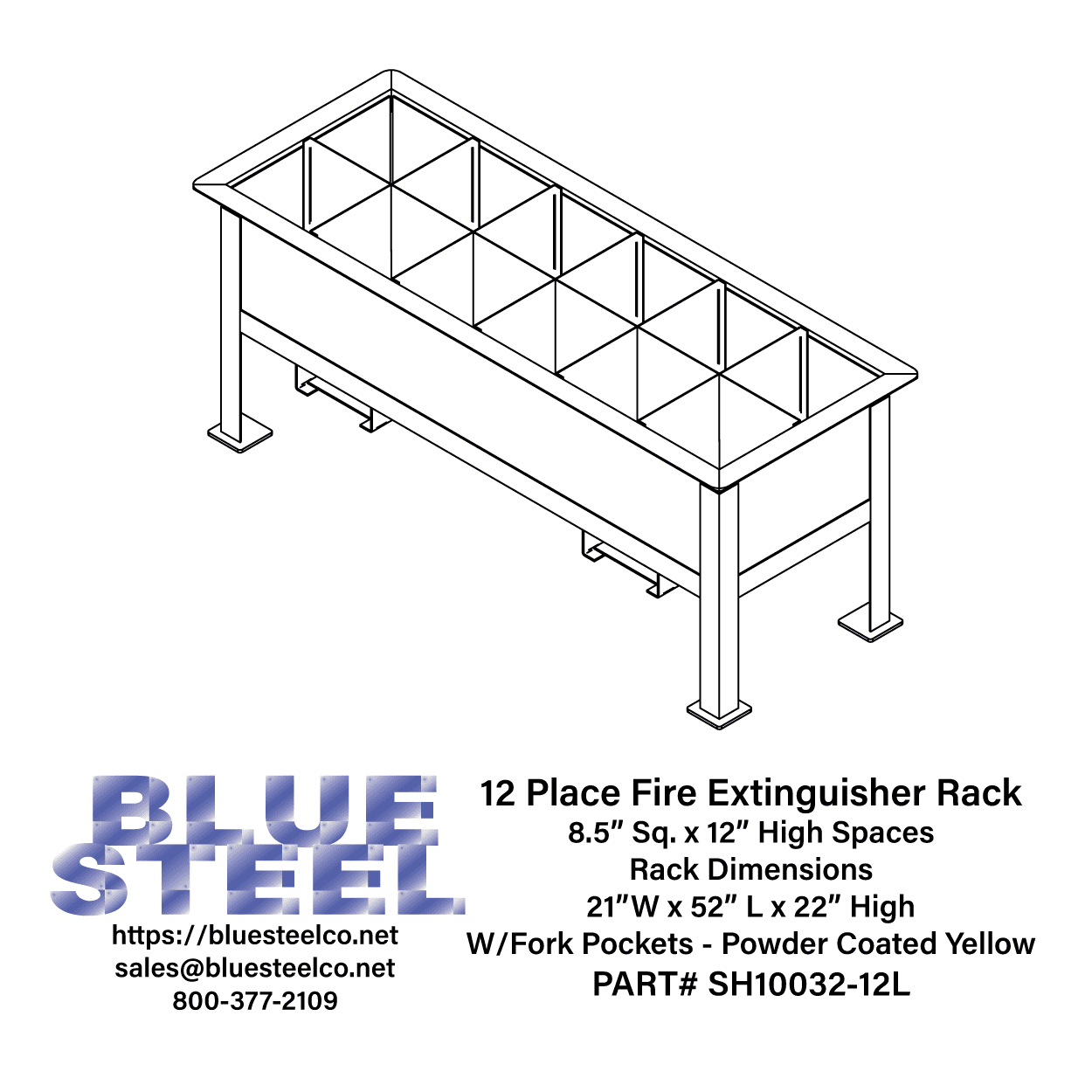
- Standardize placement and visibility. A unit hidden behind pallets fails when it is needed. Welded-steel fire extinguisher storage racks keep units off the floor, visible, and reachable. Our racks ship fully assembled with forklift pockets, from a two-place hand truck at $725 to a 48-place two-tier unit at $7,309, with free shipping.
Blue SteelCo builds the equipment that holds your fire protection program together. Browse the full safety equipment line, review property maintenance options, or see our complete catalog at bluesteelco.com. The lithium-ion standard is coming. The placement and storage rules you control are already in force.
Need help auditing your extinguisher placement before the NFPA Expo guidance lands? Request a quote or call Blue SteelCo at 800-377-2109.