
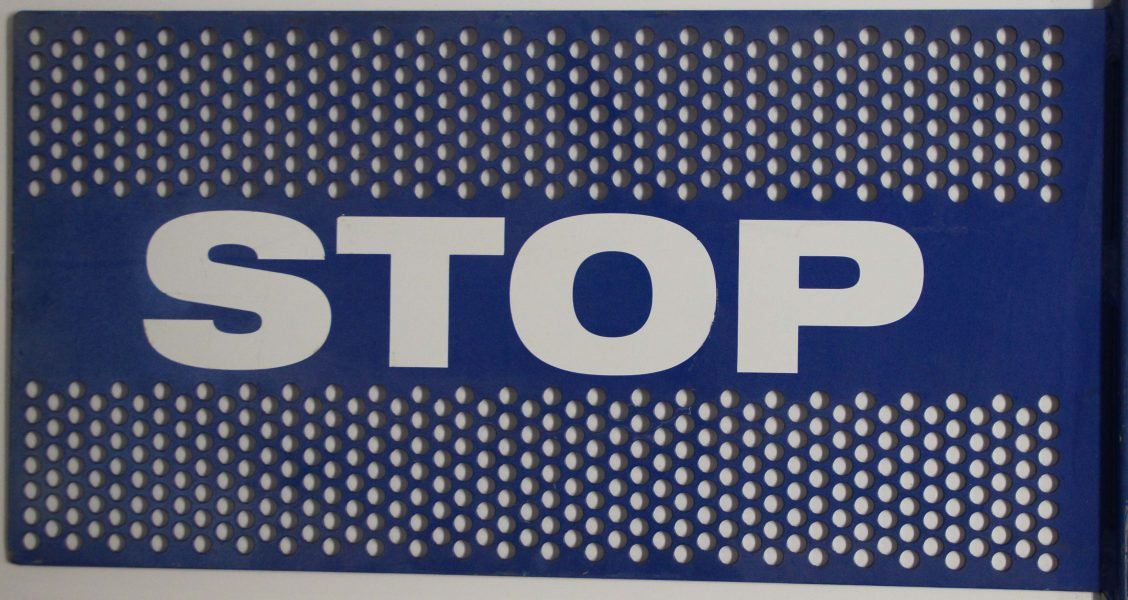
Railroad Blue Flag Signs
When a worker is on, under, or between rolling equipment, the blue flag sign is the one thing standing between them and a machine that cannot see them coming. It has to be readable across a rail yard, survive grease and crosswind, and stay exactly where it was placed until the worker who set it returns to remove it. That is the entire job of a railroad blue flag sign. It is the job Blue SteelCo has built this hardware for since 1997.
What a Railroad Blue Flag Sign Has to Do
A blue flag sign tells everyone in the area that protected equipment may not be moved, coupled to, or have any car placed against it while workers are on, under, or between it. For that message to actually protect a crew, the sign has to do three things every shift:
- Be seen. Clearly visible to any employee who might otherwise move the equipment, across the distance of a yard or shop track.
- Stay put. Secured so it cannot drift, fall, or blow out of position in crosswind.
- Stay under the crew’s control. Placed and removed only by the worker it protects.
A sign that blows down, fades, or gets knocked aside is not a minor inconvenience. In a rail maintenance environment it is the difference between a controlled work zone and a struck-by incident.
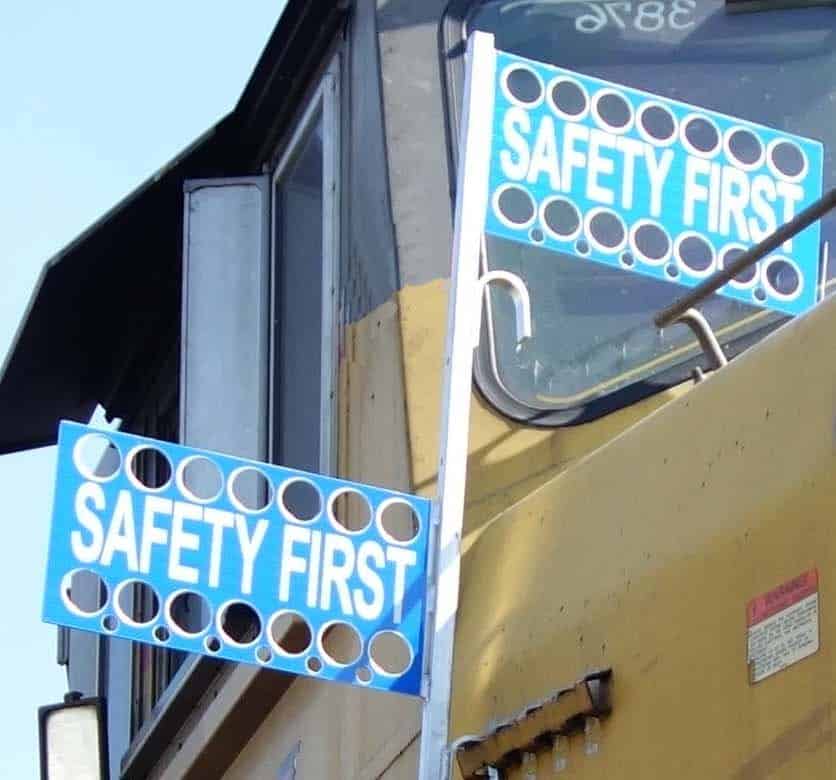
Blue Flag Signs, Flag Holders, and Flags: Sorted Out
These terms get used interchangeably, but they are three different pieces of the same protection system:
- The blue flag (or panel) is the blue signal itself, displayed during daylight work.
- The flag holder or sign holder keeps the flag standing where it is needed, whether that is a free-standing base on a shop floor or hardware staged at a repair track.
- Derail and barrier signage marks a derail or work zone with fixed signs, often carrying “STOP” and derail “D” indicators.
Most rail maintenance operations need more than one of these. A repair track might use free-standing flag holders at each end and a derail gate arm at the point of protection. For the complete product line, see our blue flag protection equipment page.
FRA Compliance for Blue Flag Signs (49 CFR Part 218)
Blue flag signage falls under the Federal Railroad Administration’s blue signal protection rules in 49 CFR Part 218, Subpart C. The parts that matter most for signage:
- §218.23 requires a blue signal displayed whenever an employee is on, under, or between railroad equipment.
- §218.29 allows only the employee who placed the blue signal to remove it. Not a foreman, not a supervisor.
- §218.31 requires the signal to be clearly visible to anyone who could move the equipment.
The FRA does not certify or approve specific brands of blue flag signs or holders. Compliance is about how the signal is displayed, how visible it is, and who controls it, not a stamp on the hardware. For the full regulation breakdown, see our blue flag and blue signal protection guide, and for the worker-protection rules behind it, blue signal protection of workers.
“Are Aldon blue flag sign holders FRA-compliant?” Because the FRA does not certify brands, no sign holder is “FRA-certified,” ours or anyone else’s. What matters is whether the holder lets you display a clearly visible blue signal that only the protecting worker removes. Blue SteelCo builds its flag holders and derail signage to meet those Part 218 requirements for the rail maintenance environment.
Blue Flag Signs and Holders from Blue SteelCo
We build blue flag signage for the conditions a rail yard actually throws at it: wind, grease, tight clearances, and the need for a fast, secure display every shift. Every piece is fabricated in the United States.
| Product | Model | Built for |
|---|---|---|
| Free-standing standard flag holder | SH10290 | Shop floors, repair tracks, inspection pits. Holds up to four standard blue flags, no mounting hardware required. |
| Aluminum derail gate sign | SH10095M | Derail and switch protection. “STOP” and derail “D” signage on a swinging gate that bolts to your existing derail post. |
| High-wind blue flag | SH10050CM | Exposed yard locations. Perforated panel passes crosswind instead of fighting it. |
| Standard blue flag | SH10400M | Normal yard and shop conditions. Solid signal panel on an aluminum staff. |
Free-Standing Standard Flag Holder (SH10290)
A free-standing flag holder that holds up to four standard blue flags, built for shop floors, repair tracks, and inspection pits where you need protection staged and ready without mounting hardware to equipment.
Aluminum Derail Gate Sign (SH10095M)
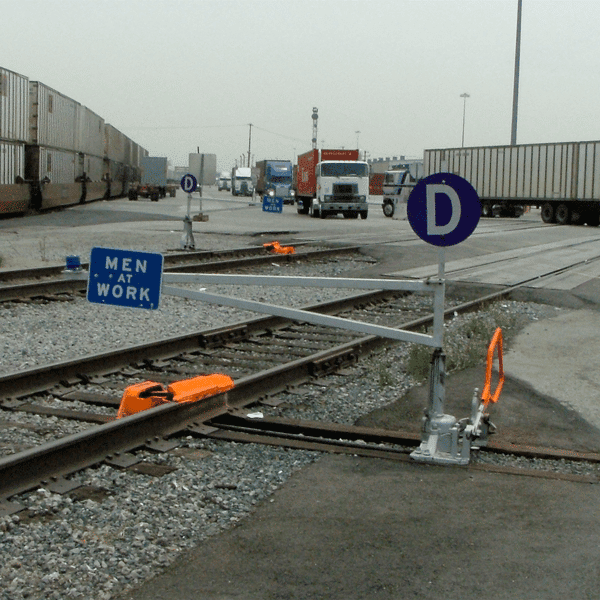
An aluminum derail gate carrying “STOP” and derail “D” signage, designed to bolt onto your existing vertical derail post. Approximately 90 inches from the derail vertical post to the end of the gate, fabricated from 1-1/2 inch aluminum square tube: light enough to swing, rugged enough for daily yard use. Full details on the derail switch barrier gate arm page.
Standard and High-Wind Blue Flags
For the flag itself, choose the standard solid panel (SH10400M) for normal conditions or the perforated high-wind panel (SH10050CM) for exposed locations. Both are covered in detail on the standard blue flag protection page.
Built for the Rail Maintenance Environment
Crosswind, grease, tight clearances, and a crew that needs protection staged in seconds: that is what blue flag signage lives in. Blue SteelCo fabricates every flag holder and derail sign in the United States and has supplied railroad maintenance facilities, transit authorities, and industrial rail operations since 1997. We also build red flag protection for fueling operations on the same hardware standard.
Request a Quote
Tell us your yard or shop configuration and we will spec the flag holders, flags, and derail signage for it. Purchase orders and Net 30 terms available for qualified accounts.
Or call 800-377-2109 · [email protected]
Frequently Asked Questions
What is a railroad blue flag sign?
It is a blue signal, a flag, panel, or sign, displayed to show that workers are on, under, or between railroad equipment. While it is displayed, the protected equipment may not be moved, coupled to, or have any car placed against it.
Who can remove a blue flag sign?
Only the employee who placed it. Under 49 CFR §218.29, a foreman, supervisor, or any other worker may not remove another employee’s blue signal.
Do blue flag signs need a blue light?
During daylight, a blue flag or panel is the standard signal. In covered shops, roundhouses, and night operations, a blue light is used in addition to the flag because overhead lighting does not always give enough contrast to see a flag clearly.
Are blue flag sign holders one-size-fits-all?
No. A free-standing flag holder suits shop floors and repair tracks, while derail and switch protection uses fixed signage like an aluminum derail gate. The right hardware depends on where the protection is needed and how it has to be displayed.