

NFPA 10 2026 Changes: What Industrial Facilities Must Update Now
Key Points
- The 2026 edition of NFPA 10 adds an optional performance-based inspection program, new disposal requirements for non-DOT condemned cylinders, and a single consolidated definition of foam agent.
- None of the 2026 flexibility applies until your state or local jurisdiction adopts the edition. OSHA 1910.157(e)(2) monthly visual inspection stays enforceable today.
- OSHA serious violations now reach $16,550 each, with willful or repeated violations up to $165,514. Fire extinguisher citations remain on the most-cited list for general industry.
- Facility managers should treat the next inspection cycle as the deadline to confirm adoption status, update recordkeeping, and review foam and disposal practices.
The 2026 edition of NFPA 10, the Standard for Portable Fire Extinguishers, is published and in circulation. The changes are not cosmetic. They affect how facilities inspect, document, and dispose of fire extinguishers across steel mills, foundries, railroads, chemical plants, and warehouses. This post maps the specific differences from the prior edition, explains how they interact with OSHA enforcement, and identifies what to update before your next inspection.
Chapter 7: The Performance-Based Inspection Program
The headline change is a new optional inspection model. The prior 2022 edition required a fixed monthly inspection frequency with no alternative. The 2026 edition introduces a performance-based inspection program that allows facilities to adjust inspection frequency based on documented performance history and a risk evaluation. The edition also formally recognizes electronic monitoring and other approved technologies that can supplement or, in some cases, replace certain manual checks.
For a large industrial campus with hundreds of extinguishers, continuous electronic monitoring is positioned as a way to reduce labor hours and tighten recordkeeping. That is the promise. Here is the trap.
The performance-based program only becomes available once your state or local authority having jurisdiction adopts the 2026 edition. Adoption is not automatic and it is not uniform. Many jurisdictions are still operating under earlier editions. Until your AHJ adopts 2026, you cannot rely on the new flexibility, and the monthly inspection requirement in OSHA 1910.157(e)(2) remains the enforceable floor regardless of what NFPA publishes.
Treat this as a sequencing problem. Confirm your jurisdiction’s adopted edition in writing before you change a single inspection schedule. A reduced inspection frequency that is legal in one county can be a citation in the next.
Chapter 8: Condemned-Cylinder Disposal
The 2026 edition adds disposal requirements for condemned cylinders that fall outside DOT or Transport Canada regulation. This category previously lacked specific guidance in NFPA 10. If a cylinder fails hydrostatic testing or internal examination and is not governed by DOT rules, the new edition gives you a defined path for taking it out of service.
For industrial sites, this intersects with hazardous waste handling. A condemned cylinder may still hold residual agent or pressure. Coordinate your disposal procedure with your EPA hazardous waste obligations and any state environmental rules before the cylinder leaves the property. Document the chain of custody. That paperwork is what protects you if an inspector or an auditor asks how a condemned unit was retired.
The Foam Definition Change and PFAS
The 2026 edition consolidates three previously separate foam terms into a single definition of foam. The prior language treated aqueous film-forming foam, film-forming fluoroprotein foam, and synthetic fluorine-free foam as distinct categories. The consolidation reflects the broader regulatory move away from PFAS-based foams toward fluorine-free alternatives.
If your facility runs foam extinguishers, this is a signal to inventory what you have. PFAS regulation continues to tighten at the federal and state level, and aging AFFF stock is a growing liability. The code change itself does not force a swap, but it aligns the standard with where agent selection is heading. Review your selection criteria during your next maintenance interval rather than waiting for a separate mandate.
What OSHA Still Enforces Today
NFPA 10 is a consensus standard. OSHA 1910.157 is law. The two work together, and OSHA enforces its own requirements no matter which NFPA edition your jurisdiction has adopted. The current baseline:
- Monthly visual inspection under 1910.157(e)(2).
- Annual maintenance.
- Six-year internal examination for dry chemical units.
- Twelve-year hydrostatic test for dry chemical units.
The penalty schedule that took effect January 15, 2025 sets serious and other-than-serious violations at up to $16,550 each. Willful or repeated violations run up to $165,514. Failure to abate runs up to $16,131 per day. Portable fire extinguisher requirements remain on OSHA’s most-cited list for general industry, and the agency’s Warehousing and Distribution Center National Emphasis Program is active through mid-2027.
The enforcement record is concrete. On July 11, 2024, Dollar General agreed to a $12 million corporate settlement with the U.S. Department of Labor after a multi-year inspection history that exceeded $21 million in proposed penalties across roughly 240 inspections since 2017. Cited conditions included failing to inspect fire extinguishers at least monthly under 1910.157 and blocking access to extinguishers and exits. The consent agreement set future blocked-access violations at up to $500,000 each. The lesson for industrial operators is direct: monthly inspection and clear access are not paperwork formalities.
What to Update Before Your Next Inspection Cycle
Run this list now. First, confirm in writing which NFPA 10 edition your AHJ has adopted. Do not change inspection frequency on the assumption that 2026 applies. Second, hold to monthly visual inspections under 1910.157 until you have documented authority to do otherwise. Third, inventory foam extinguishers and flag aging PFAS-based stock for review. Fourth, write a condemned-cylinder disposal procedure that lines up with your hazardous waste obligations. Fifth, verify physical access. Blocked extinguishers are one of the simplest violations to write and one of the most expensive to settle.
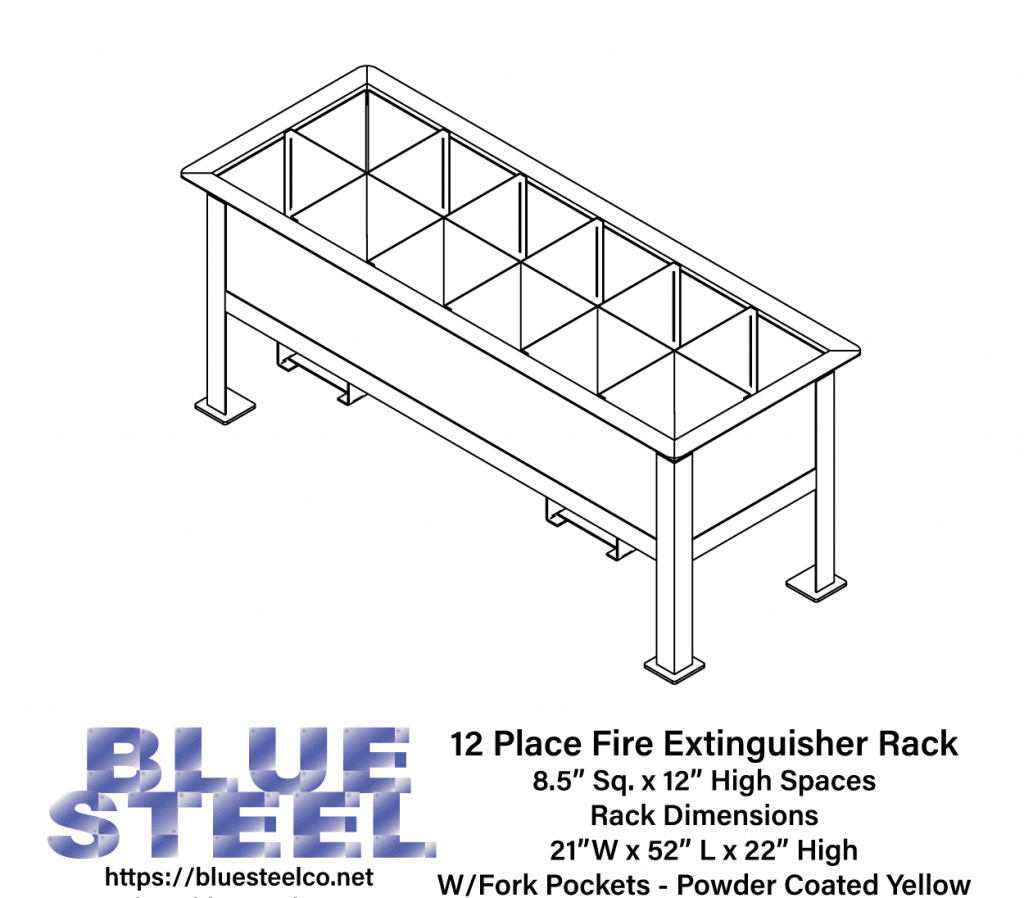
Access starts with storage. Extinguishers stored on the floor, behind pallets, or in walking paths invite both citations and slow emergency response. Welded-steel fire extinguisher storage racks from Blue SteelCo keep units visible, off the floor, and reachable. Models range from a 2-place hand truck at $725 to a 48-place two-tier unit at $7,309. Every rack is powder-coated, fitted with forklift pockets, and ships fully assembled with free shipping. Pair clean storage with a documented inspection log and you close the two most common gaps OSHA finds.
Fire compliance is one part of a wider safety equipment program. Rail operators managing extinguisher placement alongside blue flag protection and locomotive work platforms face overlapping federal standards, and the same discipline applies across shop tools and property maintenance. Build the recordkeeping habit once and it carries across all of it.
Browse the full catalog at bluesteelco.com.
Need to bring your extinguisher storage up to standard before your next inspection? Request a quote or call Blue SteelCo at 800-377-2109. We will help you size the right rack for your facility.